Sunday, April 24, 2011

Dateline: Troy


Written by: Paul Fleischman

The last time I learned about Greek Mythology in-depth was about fifteen years ago when I was in the ninth grade.  It is no wonder that all I can recall are the names of a few of the more prominent Gods and Goddesses like Athena, Zeus, and Poseidon.  Although I do not remember many specifics about Troy, I do recall The Trojan Horse and how it was used as a decoy during the Trojan War.

Needless to say, at the start of reading Paul Fleischman’s, Dateline: Troy, I had relatively vague background knowledge.  As I began to read, I started to fill in some of the gaps I had about the Trojan War.  Fleischman gives us the less comprehensive version of Homer’s, The Iliad and includes some details of the events leading up to the Trojan War.  By doing so, Fleischman enables us to enjoy the story of this Greek Myth by making it easier to understand and follow.  The language is less complex and many details are left out. 

In addition to the story of Troy, Fleischman includes newspaper clippings from modern day times in order to show readers that although the Trojan War dates back to the Bronze Age, things in our world have sadly not changed all that much.   As Fleischman states, “The Trojan War is still being fought.  Simply open a newspaper…”

The headlines that parallel the events of the Trojan War range in date from World War I, which lasted from 1914-1918, through the Persian Gulf War, which occurred from 1990-1991.  In order for Fleischman to make his point, I feel his book should be a bit more current.  I had seen on sites like Amazon and Google Books that there is a new, revised edition of this story.  I was only able to view a few pages of the book online, but the summary of the newer edition still stated that the book still covered current events from 1914-1991.  I am wondering what changes were made in the new book.  It would be interesting to see if a newer book would include more current events. 

Fleischman’s love for history shines through in this book.  Countless hours must have been spent researching and finding the articles that were the perfect match that Fleischman was looking for.  As someone who was either not around or very young during the events recounted in this book, it was powerful to catch a glimpse into the headlines written during this time period.  Fleischman did cut off some of the articles so that you were unable to read each in full.  He left me wondering about the rest of the article. 

I think the most important thing that Fleischman achieved through this book was that he made me wonder about different events in history and he made me want to know more.  It is more interesting to read the headlines and the actual stories of the events in the past than it is to research it sometimes in a book that provides an overwhelming amount of information.  This book got me wondering what else happened and prompted me to search for more.

I was surprised to see on sites like Amazon that this book did get mixed reviews.  Interestingly, children wrote most of the negative reviews.  One critiqued Fleischman for not developing the characters and stated that it was confusing to follow from one page to the next.  Most of the children reviewed that this book would be great if you enjoyed reading mythology, but that if you did not then it would not be for you.   I think you certainly need background knowledge on both important events in American History as well as Greek Mythology prior to reading this book.  I believe this book is similar to Fleischman’s, Bull Run, in the sense that the reader does not get as much out of the book unless a lot of background knowledge is brought to the table.

I found the book to be intriguing and it did get me to think more about our modern day history and how it relates to the past.  It also sparked an interest in learning more about Greek Mythology.  I do think the book needs to be updated to include even more current events—perhaps if it did, the current high-school generation of readers would find the book more interesting and relevant to them. 

Sunday, April 17, 2011

Waiting to Waltz: A Childhood

Poems by Cynthia Rylant
Drawings by Stephen Gammell

Cynthia Rylant typically draws from experiences she has had as inspiration.  In Waiting to Waltz: A Childhood, Rylant writes a collection of poems inspired by her experiences in Beaver, West Virginia.  Rylant moved to Beaver with her mother at the age of eight and experienced sorrow, joy, love, loss, fear, disappointment, and death while she was there.

Even in this short group of poems by Rylant, we are given a glimpse into Rylant’s personality and style.  It is no wonder that Rylant has a gift for poetry—she always writes poetically even in prose.  Free-write poetry seems like a natural step for Rylant to take.  Her language does not necessarily follow any rules, but it is simply beautiful. 

This book is recommended for readers who are eleven years old and up.  I agree.  The content initially seems rather simple because all of the things are things that kids may deal with growing up.  At the same time however, a certain maturity is needed in order to interpret and appreciate the poems—especially since the poems go beyond what an eleven-year-old experiences.  For example, the later poems talk about going steady, dating, and leaving home. 

The pencil illustrations that accompany the poems almost look as though someone has spilled water on them—making them look like black and white watercolor.  They provide a glimpse into Beaver, but also leave significant details out—allowing the reader to make up their own pictures in their mind.
This group of poems allows us insight into Cynthia Rylant’s personal life and thinking—yet, we do not feel like we know everything there is to know about her when we finish.  As an adult who has read several Cynthia Rylant books, this poetry collection makes me want to learn more specific details about her childhood.  I am looking forward to reading her autobiography. 

Joyful Noise: Poems for Two Voices


Written By: Paul Feischman
Illustrated by Eric Beddows

Have you ever wondered what goes on in the minds of insects?  I do not think that I ever have.  In my adult years, I consider insects to be a nuisance.  Sure they are helpful to the environment—but I can’t help not wanting them anywhere near me.  I sometimes wonder when my opinion of bugs changed.  When I read stories like Fireflies by Julie Brinkloe or, When Lightening Comes in a Jar, by Patricia Polacco, and most recently, poetry books like Dark Emperor & Other Poems of the Night by Joyce Sidman and Joyful Noise, by Paul Fleischman, I am reminded of the summertime when I was a child.  I used to spend my time outside chasing fireflies, running around barefoot, digging in the dirt, and picking up worms.

After reading Joyful Noise: Poems for Two Voices, I am reminded of how fascinating nature is.  Fleischman carefully crafted fourteen different poems each from the perspective of a different insect.  He creates a rhythmic beat between the two voices—begging for the poems to be read aloud. 

The poems are simple and easy to understand yet incorporate a variety of literary techniques.  For example, the use of alliteration can be seen in the poem, Fireflies:

“We’re fireflies/flickering/flitting/flashing/fireflies/glimmering/gleaming/glowing”

Fleischman also incorporates rhyme in poems like The Moth’s Serenade:

“Porch/light,/hear my plight!/I drink your light/like nectar…”

In addition, Fleischman uses repetition between both voices as well as in each individual part.  For example, in Requiem, Fleischman repeated the words, “Light undying” several times in each individual part as well as in both voices.  He also repeated the phrase, “Cave crickets/mole crickets/tree crickets/field crickets” between the two voices in what seemed almost like a Row Your Boat type of round.

Fleischman enabled me to visualize and make inferences through his choice of language.   For example, through the Honeybees poem I pictured in my mind the different roles of the Queen bee and the Worker bee.  It was especially interesting to read two different perspectives within the same poem.

Accompanying each poem were simple pencil drawings by Eric Beddows.  The simplicity of these illustrations added to the interpretation of each poem without taking away from the language used in the poem itself.  The illustrations give us a more detailed look of what each insect looks like, although there is still the fictional appeal.  I do believe though that the illustrations are detailed enough to help identify the real deal.

Reading this book of poetry silently was a challenge and I could not convince anyone nearby to read aloud each one with me.  As a result, I tried to see if I could find any of these poems read aloud online.  I was lucky enough to find a YouTube video with the poems read aloud by Opera singer Louis Lebhertz and storyteller Judy Peiken.  What a difference it made to listen!  Both Lebhertz and Peiken did a beautiful job bringing the rhythms and sounds to life as Fleischman intended.  For example, in the poem, Water Boatmen, the readers rolled every “r” in the poem—adding a new dimension of rhythm.  The music that accompanied the reading of the poems added to the mood of each poem.

After reading and listening to the poems of Joyful Noise it will be difficult to not think twice before swatting at an insect that has crept into the house.  I cannot say that I will be found outside chasing fireflies, running around barefoot, or playing in the dirt--but, Fleischman did manage to give me a new perspective on insects in this brilliant collection of poetry.

Dark Emperor & Other Poems of the Night


Written by Joyce Sidman
Illustrated by Rick Allen
 
When Nightfall Comes
By Janelle Pherson

The sky begins to fall,
The sun slowly travels with it

Down,
                                                                        Down,
                                                                                    Down,

It begins to disappear.

Hues of orange and red,
A fiery glow—
Remind us of the day that has passed.

Pink and purple,
Soften the sky—
Gradually bringing nighttime to life.

A silence transpires,
But only for a moment

Slowly,
They come.

Climbing,
Creating,
Intricate spirals.

Undetectable scents
Leading the way

Watching and waiting
Dinner awaits,
The hunted,
Ruefully unaware

Still as night,
Thirsty roots
Replenish,
Rejuvenate.

Busy weaving
No need to search
A hard night’s work
Rewarded.

Learning
Survival,
Almost ready
To embark

Singing,
A beautiful sound
Setting rhythm to the night.

Rising from the surface,
They magically appear.

Purple and Pink
Begin to saturate,
Signaling the end of night

Red and Orange
Fill the sky,
Telling all it is time to go home.
                                                             
                                                                             It rises.
                                                                     Up                                     
                          Up
                   Up


A new day has begun.


The Newbery Honor book, Dark Emperor & Other Poems of the Night, written by Joyce Sidman, is a beautifully crafted collection of poetry that invites us to be careful observers of night.  Life does not stop just because we are asleep. 

Poetry can be a difficult genre to appreciate.  For me, I know I never cared for poetry because I never felt I understood it the way I was supposed to.  I was afraid to verbalize my thinking for fear of being wrong.  When I was in school, the teacher had us analyze poems and made it seem like there was only one interpretation.

Sidman’s poems helped me to feel more comfortable with my interpretations and analysis.  Sidman included a side-note for each poem, which provided background information for the creature the poem was written about.  I felt this enabled me to truly appreciate and understand each poem.  I found that I read each side-panel before reading the poem.  I felt I could read between the lines and make inferences. 

In addition to providing a side-panel of factual information, Sidman coupled with illustrator Rick Allen to provide even more support for the interpretation of each poem.  Rick Allen’s illustrations were unique and intricate.  Done with gouache and the stamping of carved wooden blocks, Allen was able to add remarkable detail to each illustration.  It was almost as though I was outside looking through a magnifying flashlight.  He even tied the poems together by including the different creatures in each illustration.  For example, the eft is found roaming through each illustration—much like he does in the poem written about him.

This book of poetry does remind me of Joyful Noise, the 1989 Newbery Medal winner written by Paul Fleischman.  Joyful Noise was written for two voices and focuses on different insects and bugs in nature.  In contrast, Sidman’s book focuses on any nocturnal creature.  Both books provide insight into often ignored aspects of nature.  How often do you really think about the thoughts of a bug?  I would not have thought that either book would be that appealing seeing as though I do not care for most creepy and crawly creatures, but I do feel as though I have a new appreciation.  The next time the sounds of crickets gently rock me to sleep, I will not be able to help thinking of all of the other creatures stirring in the night. 


Monday, April 11, 2011

Bull Run


Written by Paul Fleischman

Woodcuts by David Frampton

For whatever reason, I have never found the Civil War to be exceptionally interesting.  Perhaps it was because the teacher I had the year(s) I learned about it did not tell any good stories and focused on the cold, hard facts—the facts that I also read in the textbook along with a plethora of definitions and descriptions of important people and battles.  

In Paul Fleischman’s, Bull Run, we are given a synopsis of the Battle of Bull Run from sixteen different fictional perspectives.  Eight of characters are from a Northern perspective and eight are from a Southern perspective.  Within these sixteen, we read the perspectives of the rich and poor, the slaves and the free, and young and the old, and those with various jobs within the war.  Finally, history written with stories—this is certainly much more interesting than reading about the battle in a textbook.

As with other Fleischman books I have read, he continues to amaze me with his ability to write across different genres.  Bull Run, a historical fiction novel, incorporates stories that help us see Fleischman’s love for history.  As with in Graven Images, Fleischman is successfully able to write each perspective, or story within the story, in a different voice. 

Although the story was interesting, Fleischman did include sixteen different perspectives in just 102 pages.  Fleischman also wrote from several different perspectives in the short book, Seedfolks, but each person only had one chapter.  If a person was mentioned again throughout the book, it was because Fleischman made connections between characters and tied everyone together through the neighborhood garden.  In Bull Run, Fleischman had short snippits of thought from each perspective and each person had at least three or four different “chapters” in the book.  I preferred the way Flesichman incorporated the characters in Seedfolks because I felt it was easier to make emotional connections and to remember each person. 

Although Frampton incorporated woodcuts at the start of each chapter to signify the perspective that the section was written from, I still found it difficult to keep each character straight.  Fleischman did provide a page in the back of the book that listed each character and their loyalty.  Although this was helpful, I did not feel I should have needed to constantly flip pages in order to remember characters.  It was suggested that this story be performed as Reader’s Theater.  I do think that this would be the best way to read this story.  I think it would be very helpful in fully connecting with and understanding the characters.

In order to fully appreciate this story and understand the value of this book, it is certainly necessary to have specific background knowledge on the Civil War.  I think the information provided in this story is specific to the Civil War and the time period and is not all necessarily relatable to war in general.  For example, in Cynthia Rylant’s, I Had Seen Castles, it did not matter that the story was about World War II.  Any person could gain knowledge from the story regarding different aspects and feelings from war.  In Bull Run, the story would not be as enjoyable if you did not already know information about the Civil War and the time period.


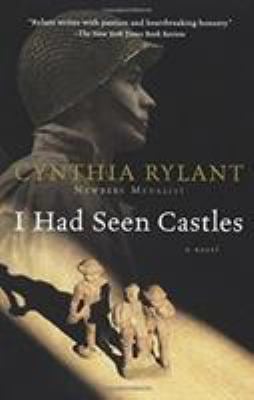
I Had Seen Castles


Written by Cynthia Rylant

I have always been an outsider to war.  When I look into the eyes of a soldier, I see a hero.  I see someone who has risked his life for our country and protected us from harm.  I see strength, bravery, and wisdom—and I am thankful that he has made it home and can find happiness with his friends and family.  When I look into the eyes of a soldier, I do not see the war—I see hope for a better future.

But, when I look into the eyes of a solder, I am, and always will be, an outsider. 

The eyes of a soldier tell a different story.  They cannot take back the unimaginable things they have seen and there are no other eyes—other than those that have seen the same—that can truly understand.

John Dante is seventeen years old in the midst of World War II.  His friends who are eighteen have already enlisted in the War.   John has mixed emotions throughout the book on whether or not to join the war, but in the end—he decides to do so when he turns eighteen. 

I Had Seen Castles, a powerful young-adult fiction novel written by Cynthia Rylant, opens our eyes not only to the brutality and horrifying experiences of fighting in a war, but to the innermost thoughts and feelings of those fighting.  It’s a story about love, loss, hope, and growing up far too fast.  

As with many of Rylant’s other books, she is able to emotionally engage us in the text through her use of descriptive text.  Her language is poetic and beautiful, even though she is describing horrifying events.  “The pictures in Life may have shown suffering and death to the people back home, but they never showed dismemberment.  The shoes with feet and legs up to the knees still standing, and nothing more.  The rest of the boy is gone.  Or the chest cavity blown wide open so that the heart can be seen, still beating, and the boy to whom the heart belongs reaches out and asks to be helped to die.” And, she put into perspective how many innocent people died, “Thirty million Russian people died in the Second World War.  Not soldiers—families.  Thirty million people.  Mothers and grandmothers, fathers and children.  They burned and bled, littering the landscape.  Their beds burned and their toys.  Their wedding pictures and their babies’ carriages.”   She helps open our eyes as readers and the way she describes death and the war makes us think about its’ true purpose.

Rylant mentions in the back of the book that although she did some research for the story, she relied heavily on her heart in order to write it.  Her inspiration for the story was due to special newspaper editions with interviews from World War II Veterans—marking it’s fiftieth anniversary.  I wonder how much information she gathered from real veterans and how much she made up or assumed a soldier would think.  I did read in a biography of Rylant that her father was a veteran of the Korean War and died when she was only thirteen.  It did not seem that she was that close to her father or knew much about him.  I wonder how much, if any, of her inspiration came from her father’s experiences.

John Dante was forever changed after the war in ways that few could understand.  After all, John had seen castles—and everything else could never be seen the same way.

Sunday, April 3, 2011

One Crazy Summer


Written by Rita Williams-Garcia

It is hard to believe that it was only fifty-five or so years ago when the United States was at the heart of the Civil Rights Movement.  When I learned about it in school growing up, it always seemed like it was such a distant thing in the past.  In thinking of the actual timeline of it, it really puts things into perspective.  It was not that long ago that our society was extremely racist and needed to go about radical change.  I think I sometimes forget that there are people still around today that were impacted by the Civil Rights Movement.  People who are my colleagues, friends, and neighbors may have either been directly affected or have parents and grandparents who were. 

Rita Williams-Garcia, author of One Crazy Summer, was one who was around and well aware of the events going on around her during the latter portion of the Civil Rights Movement even though she was a young child.  In an interview seen on Uma Krishnaswami’s blog, Rita briefly discusses her life during the late 1960s.  She mentioned how she kept a diary beginning in 1968 and went back to read it when coming up with the ideas for One Crazy Summer.  Interestingly, she had mention of the assassination of Dr. Martin Luther King Jr., and the arrests of James Earl Ray and Sirhan Sirhan.  She also mentioned how two of her cousins were Black Panthers and one even highjacked a plane. 

Williams-Garcia talks about how she did not want to necessarily write about specific memories that she had, but more about the overall feeling during that time period.  Through Delphine, Vonetta, and Fern we learn that children were involved as much as many adults were with the movement.  We also learn a little bit about the Black Panthers, which was founded in Oakland, California, in 1966 by Bobby Seale and Huey Newton. 

When Delphine, Vonetta, and Fern’s mother Cecile abandoned them in Brooklyn just after Fern was born, they were told it was because she was not allowed to name Fern what she wanted to name her.  The girls never knew much about their mother, other than that Big Ma did not think highly of her.  When their father sends them to Oakland, California in the summer of 1968 to visit their mother, the girls finally get a glimpse into their past and into who their mother really is.

Through the language of the text, we learn how strong and mature Delphine is.  From the very beginning on page 14, Delphine describes the term, “Mother.”

“Mother is a statement of fact.  Cecile Johnson gave birth to us.  We came out of Cecile Johnson.  In the animal kingdom that makes her our mother…Cecile Johnson—mammal birth giver, alive, an abandoner—is our mother.  A statement of fact…Mommy gets up to give you a glass of water in the middle of the night.  Mom invites your friends inside when it’s raining.  Mama burns your ears with the hot comb to make your hair look pretty for class picture day.  Ma is sore and worn out from wringing your wet clothes and hanging them to dry; Ma needs peace and quiet at the end of the day.  We don’t have one of those.  We have a statement of fact.”

Even though she is eleven years old, Delphine assumes the role of mother and takes care of her sisters.  She shows her strength when she decides the girls are no longer going to eat take-out and she stands up to Cecile by insisting on cooking in the kitchen.

Williams-Garcia put snippets of fact throughout her powerful story that make it more believable and put us into the setting of the times.  For example, the Black Panthers do have a Free Breakfast Program, which was set up to feed the inner city youth every morning before school.  The Black Panthers also began in Oakland during this time period and many important Black Panther activists were named and discussed.  I tried to find out more about educating the youth, but was mostly unsuccessful.  I did find out that the Black Panthers did set up the Intercommunal Youth Program in 1971 in order to educate many African American children who were deemed, “uneducable” by the system.  I wonder if summer camps did exist where children went to be educated about the Black Panthers after being served breakfast. 

The theme of abandonment occurs not only in this story, but also in Moon Over Manifest, and Turtle In Paradise, both historical fiction novels set during the Great Depression.  The difference; however, with the abandonment in One Crazy Summer, is that the girls get to meet their “long-lost” mother—knowing it is their mother.  It is sad to read the disconnect Cecile has with her children.  She will not even call Fern by her name—just, “Little Girl.”  She sends the girls to get take-out for dinner everyday and will not allow them into the kitchen.  At first, I thought the girls would have been better off never meeting their mother.  At least in their hearts, they could think that she maybe cared about them.

I was surprised to see the changes in Cecile as the end of the story neared.  I am not sure I expected her to become the character that she did.  Garcia-Williams showed the progression of her character over time as she turned into more of a mother.  It started slow, by letting Delphine into the kitchen to cook home-cooked meals and getting the girls a radio so they’d have something to do.  By the end of the story, after Cecile’s arrest, she opens up to Delphine about her past and tells Delphine that Fern’s name was to be Afua.  As the girls board the plane to return home, we are not sure what will become of them and their relationship with Cecile.  Will they ever see each other again? 

“We broke off from the line and ran over to hug our mother and let her hug us...We weren’t about to leave Oakland without getting what we’d come for.  It only took Fern to know we needed a hug from our mother.”

Perhaps that is the hope that we as readers need to know.  Everything will be okay with Cecile and the girls.  Things will hopefully only get better in the future.