Showing posts with label Realistic Fiction. Show all posts

Monday, May 9, 2011

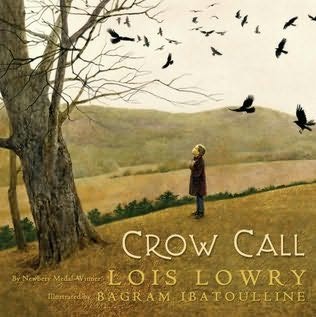
Crow Call


Written by Lois Lowry

Illustrated by Bagram Ibatoulline

I was fortunate to have stumbled upon Lois Lowry’s, Crow Call, as I was looking through the picture book section for another book written by an “L” author.  I did not realize Lowry had ever written a picture book—and realized later through her website that this was her first.  I was immediately drawn to the book because there was something about the title and the illustrations on the front and back cover that reminded me of one of my favorite picture books, Owl Moon, written by Jane Yolen. 

Through the story of Crow Call, Lowry retells a true story from a childhood—an early morning when she went crow calling with her father in 1945 after his return from World War II.  Early on, we realize that the young girl is rebuilding her relationship with her father and hardly feels like she knows him anymore.  She says, “I practice his name to myself, whispering it under my breath.  Daddy.  Daddy.  Saying it feels new.  The war has lasted so long.  He has been gone so long.”  Later, the father asks, “What’s your favorite thing to eat in the whole world?”  The young girl responds, ““Cherry pie.”  I admit.  If he hadn’t been away for so long, he would have known.”

As the story continues, the young girl Liz becomes more and more comfortable with her father.  Similar to Owl Moon, Crow Call shows the powerful relationship between father and daughter and the importance of bonding.  The story is told through the perspective of the young girl, and Lowry incorporates a lot of dialogue between the young girl and her father in addition to the young girl’s innermost thoughts.  For example, a conversation about war: ““Daddy,” I ask shyly, “were you scared in the war?”  He looks ahead, up the hill, and after a moment he says, “Yes.  I was scared.”  “Of what?” “Lots of things.  Of being alone.  Of being hurt.  Of hurting someone else.”  “Are you still?”  “He glances down.  “I don’t think so.  Those kinds of scares go away.””  What a powerful conversation for the two of them to be having—it provides a chance for Liz to get to know her father on a deeper level—and a chance to understand an aspect of war.

Lowry writes using poetic and descriptive language.  For example, “I try not to laugh, wanting to do rabbits next, but I can’t keep from it.  He looks so funny, with his neck pulled away from his shirt collar and a condescending, poised, giraffe look on his face.”  We can visualize this special moment where Liz’s father is being silly making a giraffe call and we feel the warmth of the relationship between the father and daughter.  Also, “I want to scamper ahead of him like a puppy, kicking the dead leaves and reaching the unknown places first, but there is an uneasy feeling along the edge of my back at the thought of walking in front of someone who is a hunter.”  We can now sense Liz’s uneasiness as she relates to her father being a hunter in the war.

As Liz and her father approach the woods, Ibatoulline creates tension through his full-bleed, double-paged spread illustrations.  The full-bleed illustrations keep us at a close-distance.  Just like in Owl Moon, we feel like we are intruding on this very special moment between a father and the daughter.  The perspective of the illustrations does change throughout the book.  At times, we are close enough to hear the conversations of the characters.  At other times, we are watching from as if we are an animal peeking from their burrow. 

The colors throughout the story make readers think of fall—shades of brown, black, and light blue saturate each page.  The trees are bare in the woods, reminding us that winter is on its way.  The trees mostly consist of diagonal lines—again creating tension and evoking emotion in the reader.  The representational style of the illustrations reminds us that this story is real as we can sense the subtleties in the expressions of the characters and understand their feelings.

Although this story is nostalgic of an event in Lowry’s childhood, I feel it is relatable to anyone—young or old.  Children today are still faced with losing their fathers to war.  Many fathers do come back, but the bond between father and daughter must be recreated in order to make up for the time that has been lost.  Lowry’s Crow Call reminds us all what it is like to get to know a loved one for what seems like the first time.

Dear Mr. Henshaw


Written By: Beverly Cleary

Illustrated By: Paul O. Zelinsky

Life is tough for Leigh Botts as he struggles to deal with the divorce of his parents, the feeling of being abandoned by his father, and the everyday difficulties that go along with being in the sixth grade. 

Beverly Cleary, author of Dear Mr. Henshaw, writes the full story in the form of letters.  What is interesting; however, is that the letters are only written from the perspective of the protagonist, Leigh.  Readers can only assume how author Mr. Henshaw responds to Leigh’s letters, as sometimes Leigh leaves little hints in his next letter.  For example, on page 35, Leigh writes to Mr. Henshaw, “I’ve been thinking about what you said on your postcard about keeping a diary.  Maybe I’ll try it.”  We know from this that Henshaw has obviously suggested to Leigh that he begin a diary to write down some of his feelings—we can assume that the diary is meant to be therapeutic for Leigh. 

Cleary strongly develops Leigh as a character that many children can relate to.  Unfortunately, many children will either indirectly or directly experience divorce and feelings of abandonment.  The book can help young readers to cope and to understand that they are not alone—there is always someone to talk to—even if it is in the form of a diary.  The book can provide insight for those who are indirectly affected by divorce.  Leigh is an only child and cannot help but feel like he is to blame for his parents getting divorced.  Through his conversations with his mother and Mr. Henshaw, Leigh begins to realize that things are not his fault.  Many children can also relate to the social challenges associated with starting middle school.  This story can either help children to develop empathy for those they may be picking on, or comfort that it will end—for those who are being picked on.

What is best about the book is the fact that the issues and topics presented in the book are truly timeless.  This story was published twenty-eight years ago in 1983.  Unfortunately, the issues that are presented in this story are still issues of today and are still relatable.  Cleary kept a neutral setting and did not include anything that would cause the book to be outdated.

Although there are not too many illustrations throughout the book, illustrator Paul O. Zelinsky did include pencil illustrations, which help readers to visualize the book.  The very first illustration on the title page is a collage of all of the major events that will occur throughout the story.  As readers read through the story, connections can be made and brought back to the beginning of the book.

There are some things in life that we cannot change and we can always look to a book to help us get through difficult times.  For some, reading may be therapeutic.  For others, writing may do the trick.  In Dear Mr. Henshaw, Beverly Cleary shows us that both have the power to help us develop and grow.

Feathers

 
Written by Jacqueline Woodson

Feathers, a realistic fiction novel written by Jacqueline Woodson that takes place in the 1970s, is about children who are trying to find their place in the world.  The protagonist of the story, Frannie, is eleven years old and much like her friends is not sure how to take it when a white, “Jesus-Boy” shows up in her classroom—one that is all black.  Sean, Frannie’s older brother, deals with being deaf in a community of people who can all hear.  Another young boy from Frannie’s class, Trevor, is biracial, but has difficulty dealing with this and in turn, becomes a bully.  The Jesus Boy, although he looks white, does not identify with being so.

Woodson develops a plot that is engaging and realistic to today’s youth.  People are constantly judging each other because of their looks, skin color, disabilities, etc..  The plot is full of different situations and problems that the children face.  For example, Frannie’s brother Sean deals with the reaction of young girls when they find out he cannot hear.  For some reason, they are no longer interested once they find out he is deaf. 

Woodson never names the setting, but according to her website, she was envisioning the story to take place between the Queens and Brooklyn border.  The biggest thing that makes this evident is that Frannie and the other children are always talking about the other side of the bridge.  Since they are living on Long Island, they would have to cross a bridge to get into New York City and another one to get beyond New York City.  Interestingly though, Frannie would not have had to travel beyond the bridge in order to see how the other side lived.  From what I know about Long Island, Frannie could have also just traveled further east and would have also been in a different world.  Woodson writes After Tupac & D. Foster in a similar setting to Feathers.

Although this story won the Newbery Honor Award, I did not feel as much of an emotional connection to the story and found it difficult to get through at times.  In comparison to some of the other Newbery Award winning books, I feel like others are overall much stronger.  For example, I feel there is a world of difference between the story, One Crazy Summer, by Rita Williams-Garcia and Feathers.  Regardless though, I found it intriguing to read about a boy who was the only white kid in the class—this is certainly different from what I am used to—although, the story did remind me of when I taught in a predominately African American school.

Sunday, May 8, 2011

Will Grayson, Will Grayson


Written By: John Green & David Levithan

Will Grayson, Will Grayson, written by John Green and David Levithan, is a realistic fiction novel about two boys, both named Will Grayson, attempting to find their place in the world as they both struggle through high school.

Will Grayson, Will Grayson, is written with a unique format and style.  I cannot think of any books that I have read that are written by two different authors.  Green and Levithan decided to each write half of the book in alternating chapters.  They even split the title—with John choosing the last name of Grayson and David choosing the first name of Will.  John Green wrote the perspective of Will Grayson, the teenager who wanted nothing more than to blend in with his surroundings, but could not possibly do so while being best-friends with Tiny Cooper who is, “Not the world’s gayest person, and he is not the world’s largest person, but I believe he may be the world’s largest person who is really, really gay, and also the world’s gayest person who is really, really large.”   David Levithan wrote from the perspective of the other Will Grayson—the one who was sad, depressed, and dealing with his homosexuality.

David Levithan’s writing style is particularly interesting.  Levithan writes the entire narrative without ever capitalizing a single word.  I believe this helps readers to sense Grayson’s depression—that he is so indifferent to feeling that he does not even bother to use the shift key on the computer.  Levithan, for the most part, does not have Grayson interact with others, which authenticates his loneliness.  The most social communication Grayson has is through Instant Messenger or Facebook and is with a boy named Isaac that he has never met.

John Greene presents his Will Grayson differently.    He incorporates a lot of dialogue between Grayson, his best friend Tiny, and a girl named Jane.  Grayson does seem as though he is trying to find his place in the world, but is not as depressed as the other Grayson.  Grayson abides by two simple rules: “1.  Don’t care too much, and 2. Shut up.  Everything unfortunate that has ever happened to me has stemmed from failure to follow one of the rules.”  Throughout the story, we witness how these rules affect the relationships between Grayson and his peers and how he starts to realize he needs to change his rules if he is going to survive through life.

Finding your place in the world is something that I think all teenagers can relate to.  Regardless of whether or not you are the football captain, head cheerleader, chess extraordinaire, thespian, prep, nerd, etc., everyone in high school struggles to figure out what they really want out of life.  It is all a part of growing up and enables us to be ready to move on when the time comes.  The story can also provide hope for those who are lost.  Both Grayson characters developed throughout the course of the story.  They realized that life did not have to be so difficult and that having good friends was more important than anything.

Will Grayson, Will Grayson received the 2011 Stonewall Honor Award in the category of children’s and young adult literature.  The Stonewall award is presented to books that have exceptional merit relating to the gay/lesbian/bisexual/transgendered experience.  This book certainly took me out of my comfort zone in terms of books that I typically choose to read and I must admit, that it was difficult to get through the first section of the book because quite honestly, I couldn’t handle all of the negativity and moodiness.   As the story progressed and I got to know the characters and their perspectives better, I enjoyed reading the book and looked forward to how it would end.  Greene and Levithan brought to light the realities that young adults face today and the determination and support needed in order to make it through what can be some of the most difficult years of their lives.

Saturday, May 7, 2011

Goin' Someplace Special


Written By: Patricia C. McKissack
Illustrated By: Jerry Pinkney

Patricia C. McKissack bases her story, Goin’ Someplace Special, on the story of her own childhood.  She grew up in Nashville, Tennessee, and although the setting of her picture book has been fictionalized, she brought it to life by incorporating real events from the time.  During the 1950s, segregation was prevalent and Jim Crow signs were posted on the doors of many different public places.  Throughout the story, ‘Tricia Ann saw numerous signs as she traveled to Someplace Special.  The very first sign she saw was when she got on the bus and walked to the back of the bus, sitting behind the sign that said, “COLORED SECTION.”  She then went to sit down on a park bench, but leaped to her feet when she realized there was a sign on the bench that said, “FOR WHITES ONLY.”  Later, she was accidentally swept into a fancy hotel lobby but when was noticed by the manager he said to her, “What makes you think you can come inside?  No colored people are allowed!”  Lastly, ‘Tricia Ann passed by the Grand Music Palace and was asked by a young boy if she was comin’ in.  The boy’s older sister responded, “Colored people can’t come in the front door.  They got to go round back and sit up in the Buzzard’s Roost.  Don’t you know nothing?” 

Just when it seems that ‘Tricia Ann will never arrive to someplace special, she finally makes it—she makes it to the doorway of freedom and reads the sign above the door, “PUBLIC LIBRARY: ALL ARE WELCOME.”  In her Author’s Note, McKissack writes about how in the late 1950s, Nashville’s public library board of directors quietly voted to integrate all of their facilities.  It was one of the few places where there were no Jim Crow signs and blacks were treated with some respect.  She continues to write that she did indeed make the walk to the library by herself just like ‘Tricia Ann and did face all kinds of racial bigotry and discrimination along the way. 

McKissack strongly develops ‘Tricia Ann in such a short time.  As ‘Tricia Ann embarks on her journey she is strong and feels great pride.  As she is constantly faced with discrimination, she begins to break and her strength seems to subside.  Many kind African American friends tell her things throughout her journey like, “Don’t let those signs steal yo’ happiness.”  She almost does let others steal her happiness, but she recalls her grandmother’s steady voice saying, “You are somebody, a human being—no better, no worse than anybody else in this world.  Gettin’ someplace special is not an easy route.  But don’t study on quittin’, just keep walking straight ahead—and you’ll make it.”  Through these words, ‘Tricia Ann musters up the courage to continue on her journey and to not let others take her happiness away.

Jerry Pickney’s beautifully detailed watercolor illustrations that accompany the text engage readers and make them feel a part of the story.  His illustrations are full-bleed, allowing us to feel the same emotions as ‘Tricia Ann.  He uses bright colors of turquoise, yellow, and red for ‘Tricia Ann’s outfit—making her standout from the crowd.  The remaining scenery and people are illustrated in more muted colors—almost decreasing their significance to ‘Tricia Ann—like she is keeping her eyes straight ahead with the library as her goal.  His illustrations are a combination of representational and impressionistic in style—objects and people in the foreground are drawn accurately; but he emphasizes light, movement and color over detail in the background.

Through this story, we are given a glimpse into racial segregation and how it affected day-to-day life for African Americans.  It reminds us of how far we have come since the 1950s, which was not too long ago.

After Tupac & D. Foster


Written By: Jacqueline Woodson

The story of After Tupac & D. Foster, written by Jacqueline Woodson, takes place in the early nineties in a close-knit African American neighborhood in Queens, New York.  Two girls, Neeka and the story’s narrator, are eleven years old and have been best friends all of their lives.  The summer they meet D. Foster, they begin to learn more about themselves, each other, and the world around them as they grow to be inseparable over the course of the two-year friendship with D.

Woodson sets this realistic fiction novel during the time when Tupac was still alive.  She cues readers in on the life of Tupac and how he was tragically killed throughout the plot of the story.  For example, at one point, the narrator and her mama discuss an article written in the Daily News about Tupac.  They discuss how Tupac will do time for charges filed against him by some girl.  I was able to locate an article in the NY Times from 1993 that seems to describe the same incident—minus the perspective of the African American community.

D. Foster does not know who she is at the beginning of the story.  She does not know who her mother is and is not sure whether she has any brothers or sisters.  She calls herself D. Foster, because she is a foster child.  D. relates to Tupac; however, and his music. The narrator reflects, “You listen to Tupac’s songs and you know he’s singing about people like D, about all the kids whose mamas went away, about all the injustice.  Brenda throwing away her baby, the cops beating some brother down, the hungry kids, sad kids, kids who got big dreams nobody’s listening to.  Like over all that time and distance he looked right across the bridge into Queens, New York—right into Desiree’s eyes.  Strange how he saw her.”

Although the story is only 152 pages long, Woodson manages to incorporate a lot of tough subtopics that were and still are a reality of today.  For example, Neeka’s brother, a homosexual, was wrongfully put into prison because of a crime he was framed for.  Woodson describes the prison through the narrator’s perspective, “The loudest sound in the world is the soft click of prison gates locking behind you.  Maybe it’s how final it is—the loud slam of the gate, then the quick, gentle click.  Then the scary feeling of it all being forever.”  Both Neeka’s and the narrator’s fathers are both absent, and their mothers both work hard to support their families.  In addition, D. Foster is biracial, and the young girls comment on her green eyes and light hair.

I was around the same age as D. Foster, Neeka, and the narrator when this story took place in Queens.  In fact, I only lived about forty minutes away from the girls—but, from what I can remember, my life seemed completely different.  At the time, I am sure I did not know who Tupac was nor was I probably able to listen to his music.  Meanwhile, these three girls listened to his music and it meant the world to them.  Although I could not personally relate to most events in the story, I felt emotionally connected to the characters, which made the story both interesting and engaging.

Sunday, May 1, 2011

A Mango-Shaped Space


Written by: Wendy Mass

Young children likely believe that the way they perceive letters, numbers, and sounds is the same way that others do.  It would be hard to imagine any different as a young child—especially if the experiences you have are all that you know.  By the same token, those who do perceive letters, numbers, and sounds the same way as the majority of those around them have a hard time understanding what it must be like for those who do not.   A person cannot truly understand what it is like to have a disability, unless they have one.  The best that we can do as educators and parents is to promote awareness and to teach understanding and compassion. 

Have you ever heard of the condition known as synesthesia?  Prior to reading the novel, A Mango-Shaped Space, by Wendy Mass, I had not heard of this condition.  Synesthesia is a rare condition that is basically joined perception of the senses.  For example, one with synesthesia may associate different colors with different numbers or sounds.  In this case, every time the number 4 is mentioned or seen, a person with Synesthesia may associate the number 4 with the color green or the smell of chocolate.  This is an involuntary neurological response of the senses and can be different for each person experiencing synesthesia.

It is not until the protagonist, Mia, is in the third grade that she realizes that other children do not perceive letters and numbers the same way that she does.  After being called up to the board to do a math problem, Mia tries to write the numbers in the colors that she sees in order to help her solve the problem.  As she is doing this, her teacher believes that she is fooling around and is annoyed with her for wasting time.  In a long embarrassing moment between the teacher and Mia, the children end up laughing and calling Mia a freak, and the teacher gets tired of the nonsense and ends up sending Mia to the principals office.  She states, “Numbers don’t have colors, they simply have a shape and a numerical value, that’s all…”  A Mango-Shaped Space takes us through the experiences, both positive and negative, that a young girl Mia deals with as she learns to cope with who she is and discovers that she is not alone. 

Within the first three pages of the book, Wendy Mass brings our attention to the importance of awareness.  It is disheartening to read about the teacher’s reaction to Mia’s problem.  It only took one event that lasted less than 3 minutes to completely destroy Mia’s perception of herself.  Nobody believed what Mia was saying about the colors to be true.  They all thought that it was nonsense—and Mia was forced to deal privately with this condition until she was thirteen.

Wendy Mass won the Schneider Family Book Award, which is given to an author or illustrator that “embodies an artistic expression of the disability experience for child and adolescent audiences.”  Mass does not have synesthesia, nor did she originally know anyone with the disorder.  In the FAQ section of her website, Mass states that her inspiration for the book came from reading another book titled, The Man Who Tasted Shapes, by Dr. Richard Cytowic.  She mentioned that she found the book fascinating and it was at that moment she decided to create a fictional character that would have this condition.  She did do a lot of research on synesthesia and even attended meetings of the American Synesthesia Association.  Although she did not originally know anyone with the disorder, she was fortunate to meet many wonderful people who shared their experiences with her and helped her understand what Mia may have been going through during school.

Mass develops the character of Mia very well and she is one that anyone could relate to.  Teenagers are trying to find their place in the world during the difficult years of middle and high school.  This happens regardless of whether or not you have a disability.  Mia is a character that struggles with the day-to-day problems that most children face.  She had difficulty with friendships, relationships with boys, prioritizing, getting along with her siblings and her parents, among other struggles.

I have been shown the video, F.A.T. City on a couple of different occasions during my teaching career.  This video gives perspective on what it is like to be a child with a disability in the classroom.  It allows teachers to, “walk a mile” in the shoes of those who have a disability.  It is a very enlightening video and helps us as teachers realize that we need to be more aware of the different disabilities and struggles our students are facing.  It provides awareness that will hopefully prevent any incidents from occurring that are similar to Mia’s third grade experience. 

Although four years had passed and it seemed as though everyone else may have forgotten, Mia still had not forgotten the dreadful day in third grade when she realized she was not like everyone else.  These negative memories can last a lifetime and it is important that children and adults alike are made aware of differences and learn to not only accept them, but to appreciate them.


Sunday, March 20, 2011

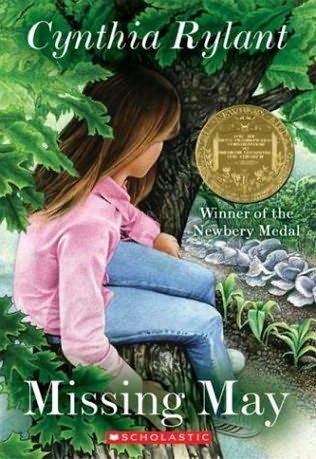
Missing May

Written by Cynthia Rylant

The loss of a loved one is a tragedy that all of us will go through at some point in our lives.  Loved ones are taken from us at many different points —sometimes unexpectedly and other times we are given the opportunity to prepare ourselves the best that we can.  I often wonder why it seems that some suffer much more loss than others—and much earlier in life than they should.  How do young children learn to cope with the loss of a loved one—especially when feeling like the adults in their life need their support?

By the age of twelve, Summer has already suffered from a lot of loss.  Since her mother’s death when she was a baby, Summer was passed from one relative to another where she was, “treated like a homework assignment somebody was always having to do.”  Finally, when Summer was six years old, she found a family who loved her—a family that needed her.  She was taken to live in West Virginia with her Aunt May and Uncle Ob. 

Summer finally felt she had come home when she was surrounded by, “Whirligigs of Fire and Dreams, glistening Coke bottles and chocolate milk cartons...”  She lived a happy, yet simple life, up until the point when her Aunt May died unexpectedly.  Summer and Ob’s lives would never be the same as they learned how to grieve and continue to live through their great loss.

Summer suffers in silence as Ob suffers outwardly.  She tries to be his strength when he cannot get out of bed in the morning.  At the breakfast table, Summer drinks coffee and Ob drinks cocoa—making it clear who takes care of whom.   She worries and is saddened by the fact that she is not enough to keep Ob going.   She thinks, “I wasn’t enough to bring Ob to life each day.  That it wasn’t enough he had me left to still love.”  Although she is hurting, she remains strong for Ob, hoping that he will things will go back to the way they were—or as close to the way they were without May being around.

Cletus, a boy from school, helps Ob in particular with his grief.  He talks to him with the maturity of an adult and is described by Summer as “...Always living full of hope and confidence.”  Though resistant to it at first, Summer and Cletus end up becoming friends as he helps both Ob and Summer through their loss.

In Cynthia Rylant’s, Missing May, we become emotionally attached to Ob and Summer as they learn to cope with their loss.  In a short amount of pages, Rylant is able to successfully develop these characters through her use of description.  She makes us aware of Summer’s thinking, but leaves us wondering about Ob’s inner-thoughts.  By the end of the story, we realize that Summer needed a sign from May that things would be alright.  The owl flying over-head was like the spirit of May—telling Summer that it was okay to cry.  Suddenly, Ob seems like a pillar of strength, comforting Summer and telling her, “She’s still here, honey.   People don’t ever leave us for good.”  It becomes apparent that Ob has realized he needs to be strong for Summer and continue to live for her.  After a breakfast of bacon and eggs, one that is cooked by Ob for the first time in his life, Cletus, Summer, and Ob set out all of the whirligigs in May’s garden—finally setting them free. 


Seedfolks


Written By Paul Fleischman


Young children have the ability to see the world from a perspective that many grow to ignore. Children hope, dream, and see beauty when adults have forgotten how to recognize it. Kim hoped that the father she never had the chance to meet would see her from heaven and recognize her as his daughter. She did not realize that the six lima beans she planted for her father would have such a significant impact on those around her. Cleveland Heights was a place made up of people of many different origins. It was a place where people avoided eye contact and did not bother to get to know each other on a personal level. It was a place where hope seemed to be lost. It was a place that has been transformed by the power of six little seeds—transformed into a community full of hope.

In Fleischman’s Seedfolks, I am left wondering and wanting to know more. Fleischman opens the window a crack and allows us to hear the voices of thirteen individuals—representing a diverse and ethnic viewpoint of the world. As I finish the book, I realize I would like to open the window all of the way and learn about the complete lives of these very interesting and very real people.

Ana is the first to notice Kim’s presence in an old lot filled with garbage and rats. She no longer sees the innocence in children and immediately assumes the worst. “I’ve never had children of my own, but I’ve seen enough in that lot to know she was mixed up in something she shouldn’t be…I just about knew what she’d buried. Drugs most likely, or money, or a gun.” Through Ana, we see how people can be hardened after many years of being witness to violence, crime, and despair.

Fleischman continues to use powerful language throughout the text, awakening the reader to the realities of many different life-styles that people live. For example, Gonzalo believes, “The older you are, the younger you get when you move to the United States.” This opens the eyes to the challenges many immigrants face when moving to a new country. Adults can no longer speak for themselves because people do not understand their language and sometimes do not bother to try to understand the broken English. My grandmother emigrated from Italy when she was eighteen years old. When I was younger, I went with my grandmother to the supermarket where she went to the meat counter and ordered chicken cutlets. In broken English, she gave specific instructions regarding the chicken to the man behind the counter. At the age of thirteen, I could sense the man’s impatience and frustrations with my grandmother. I spoke up to clarify for her—just as Gonzalo clarifies for his father when he tries to speak. Fleischman writes, “He didn’t want strangers to hear his mistakes.” This phrase speaks to how people often do not accept the differences of each other and cause people to be uncomfortable in a place they are supposed to be able to call home.

When we are introduced to Sam, we wonder how this garden will bring people together. In describing the garden, Sam notices, “…With a few exceptions, the blacks on one side, the whites on another, the Central Americans and Asians towards the back. The garden was a copy of the neighborhood. I guess I shouldn’t have been surprised. A duck gives birth to a duckling, not a moose. Each group kept to itself, spoke its own language, and grew its own special crops.” After some disturbances in the garden, people started to worry. Sam explains the precautions taken, “That week, a man put chicken wire around the garden, five feet high, complete with a little gate and padlock…Then came the first KEEP OUT sign. Then, the crowning achievement—barbed wire.” It is at this point that Fleischman makes us feel that there is no chance for a community. These people are working side by side, but remaining just as far apart as ever.

Just when you think all hope is lost, Fleischman interjects signs that the community is beginning to come together. It began when Tio Juan attempted to give Virgil advice on his lettuce crop. Next, Sae Young stands and admires the conversation between man and woman over corn. Later, Sam helps the community by having a contest for the children—awarding twenty dollars to the best solution for water transport to the garden. Sae Young feels like a part of the garden and member of a family when she notices many people using the funnels she purchased to help with filling narrow bottles with water. Leona, the strong-willed woman who convinced the city to clear the trash out of the garden, helps Maricela, a pregnant teen, regain hope and love for the life growing inside of her.

Fleischman is successful in intertwining the lives of the characters together as he shows the community forming. Even though Royce does not have his own chapter, we hear his voice and learn who he is through other gardeners. He starts off trying to go unnoticed, a young boy of fifteen who was kicked out of his home. Curtis first notices him and has him help guard his tomatoes. By the end, Amir says, “How strange it was to watch people who would have crossed the street if they’d seen him a few weeks before, now giving him vegetables, more than he could eat…He was trusted and liked—and famous, after his exploit with the pitchfork…He was not a teenage black boy. He was Royce.”

By the end of the story, we can sense the togetherness of the community as the people celebrate their fall harvest with a Harvest Festival. They shared food, conversation, knowledge, and wisdom. Perhaps in the coming years, they will stop referring to each other by their race and will begin to refer to each other as friends.